


Aortic Aneurysm Endovascular Surgery
This shows to be one of the two main forms of treatment of aortic aneurysms. Some teams of large centers are using this technique, also called as endoprosthesis implantation, for treating the aneurysms of thoracic and abdominal aortas.
The endovascular repair is relatively new. The first procedure in the world was performed in 1991. Since then, the number of procedures does not stop of growing, and the available materials are being more and more improved. In this procedure, small incisions from 3 cm to 4 cm are made at the groin area to gain access to the femoral arteries, instead of large incisions in the thorax or abdomen. An endoprosthesis in inserted in these small incisions by a catheter by the femoral artery until the aneurysm site, where it is released.
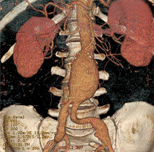
The blood flow is redirected once the endoprosthesis is released, so excluding the aneurysm from the circulation. These endoprostheses are fixated inside the aorta by their radial force or small hooks. The endoprosthesis reinforces the weakened portion of the aorta in order to prevent the aneurysm rupture. These prostheses are made of a metallic alloy called as nitinol or steel, which has high resistance and malleability, and are covered by tissue (Dacron or PTFE). The procedure cam be performed with regional anesthesia (peridural or epidural blockade) or even with local anesthesia.
As the procedure is well less invasive, the risk is lower and the recovery is faster. However, it is not exempt of risks. The patient must remain in follow-up after the procedure, undergoing periodical tomographies, mainly to be certain of the correct positioning of the endoprosthesis and to verify the occurrence of endoleaks (blood leakage between the endoprosthesis and the aneurysm). We are still waiting to evaluate the long-term results.


Peripheral Aneurysms
The aneurysms can be formed in any artery in the body, such as the iliac, femoral, popliteal, and visceral ones, including the brain ones.
The following is an example of endovascular treatment of a common iliac artery aneurysm.

Aneurysm of the iliac artery